
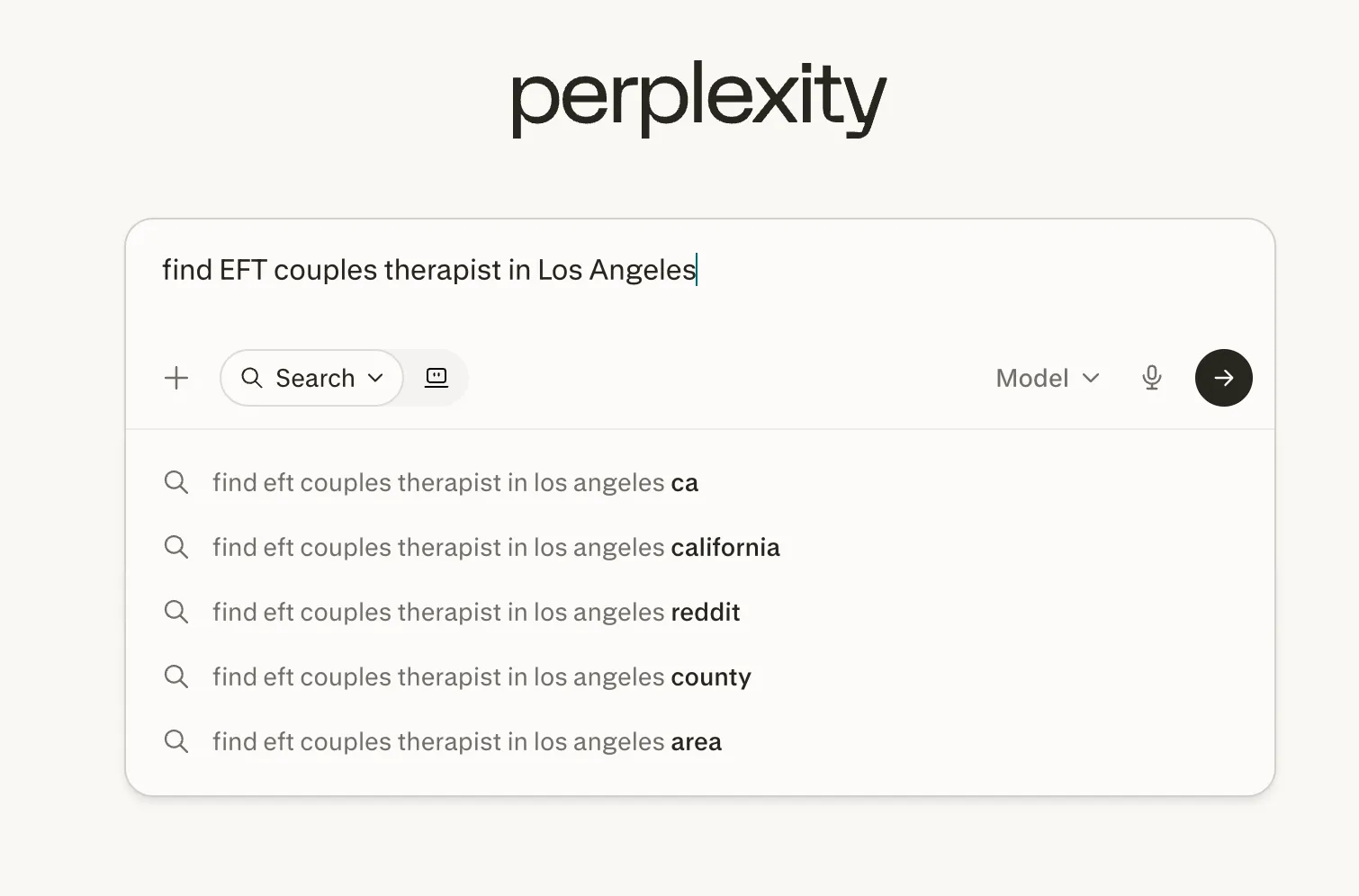
Someone is going to try to sell you “AI search optimization” for your therapy practice this year. Maybe they already have. Before you spend money on it, here’s what the research actually says.
You’ve probably seen the statistic: roughly 32% of U.S. adults have used a generative AI tool like ChatGPT for health-related information. That number gets cited a lot in marketing pitches aimed at healthcare providers. What it actually measures is broad: people asking AI about symptoms, medications, general health curiosity. Not people searching for a therapist.
No study we’ve found measures how many people specifically use AI to find a mental health provider. That’s a meaningful gap.
The scale of AI search itself is no longer in question. At Google I/O in May 2026, Google announced that its AI search features now reach over 2.5 billion people monthly, with AI-powered queries more than doubling every quarter. But the distance between “people ask AI health questions” and “people find their therapist through AI” is larger than most marketing pitches acknowledge.
This post breaks down what the evidence supports, what it doesn’t, and what you should actually do about it.
How AI search actually finds your content
There are three major AI search platforms, and they each pull from different places. This matters because it determines who sees your website and under what circumstances.
Google AI Overviews and AI Mode pull directly from Google’s own search index. If your practice ranks on Google for relevant queries, your content is in the pool that Google’s AI features draw from. There’s no separate submission process. Google’s AI does draw from beyond the first page of results, but the same things that help you rank — clear, specific content about your expertise — also make your content more likely to be cited.
ChatGPT uses Bing’s search index, not Google’s. When someone asks ChatGPT a question that triggers a web search, it queries Bing for results. This means a practice that performs well on Bing (but not Google) could still show up in ChatGPT responses, and vice versa.
Perplexity built its own independent search index tracking over 200 billion URLs, with its own crawler and ranking system.
The important takeaway: these three platforms don’t look at the same sources. A Semrush study comparing all three platforms found that citation patterns differ significantly. Google AI Overviews, ChatGPT, and Perplexity each have a distinct fingerprint in terms of which websites they cite.
But here’s what they have in common: all three favor content that is authoritative, well-structured, and backed by evidence. The source of the content differs. The quality bar does not.
What Google says about showing up in AI search results
This is the single most important piece of evidence for therapists evaluating AI search claims. Google published explicit guidance on optimizing for AI features in May 2026, and the core message is straightforward:
“From Google Search’s perspective, optimizing for generative AI search is optimizing for the search experience, and thus still SEO.”
Google goes further, specifically debunking several tactics that vendors sometimes present as necessary:
- LLMS.txt files: “You don’t need to create new machine readable files, AI text files, markup, or Markdown.”
- Rewriting content for AI: Not needed. Your existing content works.
- Special structured data: “Structured data isn’t required for generative AI search, and there’s no special schema.org markup you need to add.”
- Splitting pages into single-topic posts: Also not needed.
What Google does recommend is what they’ve recommended for years: create content that demonstrates genuine expertise, structure it clearly, and support your claims with evidence.
A peer-reviewed study from Princeton found that adding real statistics, citing credible sources, and including expert quotations measurably improved content visibility in AI-generated responses. Those are worth doing, but they’re also standard good-writing practices, not a new discipline. One caveat: the study used older versions of ChatGPT and Perplexity, so the specific numbers may not transfer to today’s systems, even if the principle holds.
Three things worth doing to show up in AI search
If the evidence points anywhere, it points here. These are low-effort, evidence-backed actions.
Make sure AI crawlers can access your site
AI platforms use their own web crawlers to index content. ChatGPT uses one called OAI-SearchBot. Perplexity uses PerplexityBot. Both respect your website’s robots.txt file, which means if your hosting provider or a past developer blocked these crawlers, your content won’t appear in their results.
Most therapy websites allow these crawlers by default. If you’re on Squarespace or WordPress and haven’t made custom robots.txt changes, you’re likely fine. But it’s worth checking, especially if you use a managed hosting provider that may have added restrictions. To check, type your website address followed by /robots.txt into your browser (e.g., yourpractice.com/robots.txt). If you don’t see OAI-SearchBot or PerplexityBot being blocked, you’re set. If you’re not sure what you’re looking at, your web developer can confirm in under a minute.
Claim your local listings — AI uses them as a directory
When someone searches for a therapist locally — “trauma therapist near me” or “anxiety specialist in Boston” — AI platforms shift behavior. Instead of summarizing web content, they work more like directory matchmakers.
Google’s AI features draw from Google Business Profile data for local queries, while ChatGPT relies on Bing Places and local directory listings. If you haven’t claimed and filled out these profiles, you’re effectively invisible to those localized searches, regardless of how strong your website content is.
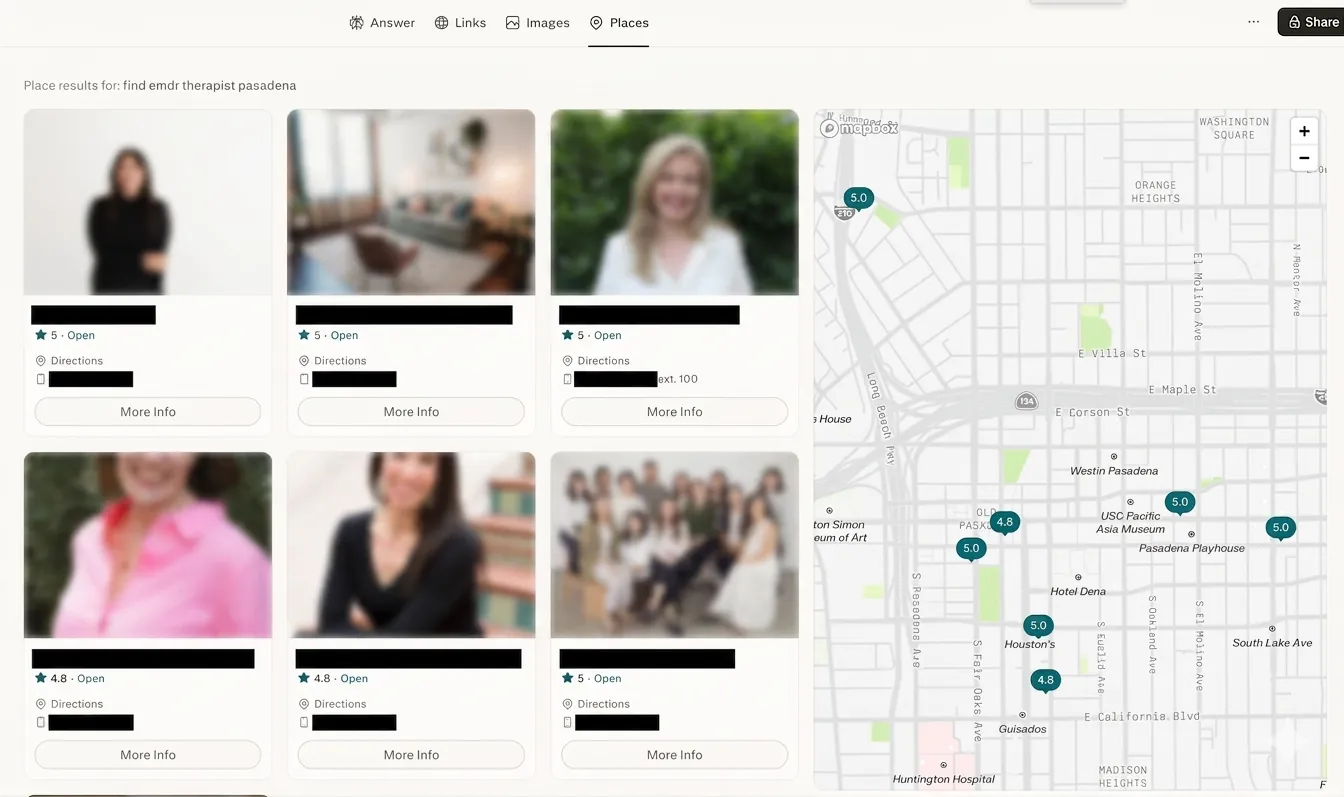
What a local therapist search looks like on Perplexity. The platform pulls practice names, ratings, hours, and locations into a Places view — all sourced from business profiles and directory listings.
A 2026 BrightLocal survey found that 45% of consumers have used AI to find local business recommendations, up from 6% the year before. But 97% of those users still double-check the AI’s suggestions against real reviews on the business profiles themselves.
AI might surface your practice initially, but trust is validated by your local presence. Two things to get right:
- Make sure your Google Business Profile and Bing Places listings are claimed, complete, and consistent with the name, address, and phone number on your website.
- List your clinical specialties in the services section of your profiles. This structured data is what AI systems use to match your practice with someone searching for a specific type of help in your area.
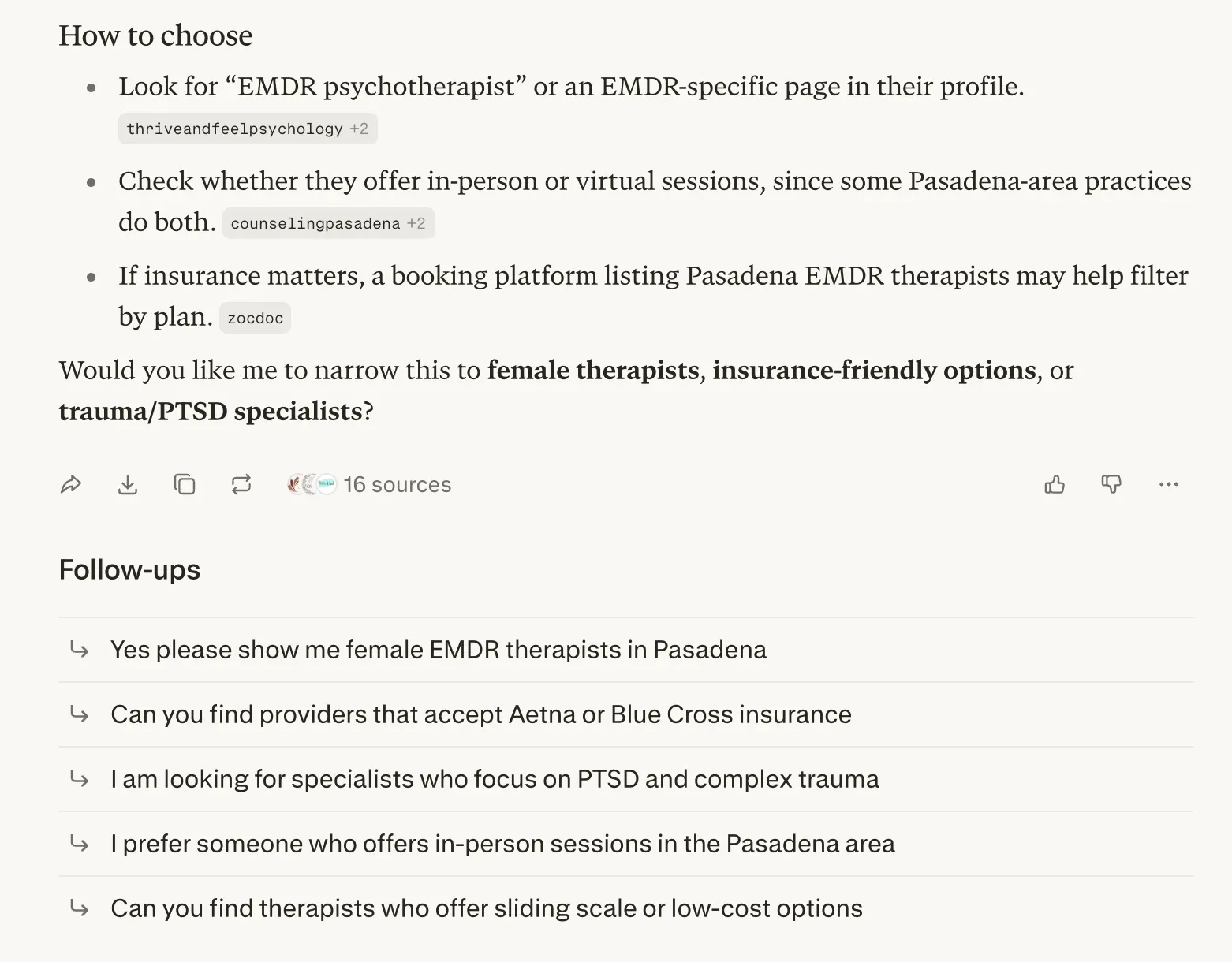
Perplexity’s follow-up prompts after an EMDR therapist search. The platform suggests narrowing by gender, insurance, specialty, session format, and cost — all details it can only surface if they exist in your profiles and website.
Microsoft also offers an “AI Performance” dashboard in Bing Webmaster Tools that shows how your content appears in AI-generated answers — worth setting up for a baseline.
Cite your sources
When you reference prevalence rates, treatment outcomes, or clinical frameworks on your website or blog, cite the source. Link to the study, the professional organization, or the clinical guideline. This is good practice for your readers, and the evidence suggests it also helps AI systems identify your content as trustworthy.
One more thing worth trying: search for your name, specialty, and city in ChatGPT and Perplexity. What comes up (or doesn’t) gives you a concrete baseline for where you stand right now.
For more on building the kind of content that performs well in both traditional and AI search, see our guide on what therapists should actually blog about.
What the evidence doesn’t support
Several claims circulating in the SEO industry deserve scrutiny when applied to therapy practices.
“You need GEO (Generative Engine Optimization) as a separate service from SEO.” The term comes from a Princeton research paper, and the work it describes is real: making your content more likely to be cited by AI systems. But the tactics that fall under GEO (adding citations, using statistics, improving clarity) overlap heavily with established content strategy best practices. The line between GEO and good SEO is blurrier than some vendors suggest. If you’re already working with an SEO provider who focuses on content quality and demonstrating your expertise, you may already be doing this work. It’s worth asking what any new “GEO” service adds beyond what your current SEO strategy covers.
“AI search is replacing Google for healthcare.” Pew Research (2026) found that 75% of Americans say it’s highly important for health information sources to have medical training. AI chatbots scored high on convenience but low on personalization (47% said chatbot health info is not personalized) and accuracy. People may start a health-related search with AI, but they still want to evaluate the provider themselves. AI and Google are not interchangeable in how people make healthcare decisions.
“AI-specific content rewrites are necessary.” Google’s own documentation says they’re not. The research supports that well-written, clearly structured content performs well in AI results without reformatting.
“You should be building a Reddit presence.” AI platforms do cite Reddit heavily across all platforms, according to the Semrush study. But Reddit’s communities are self-governing and generally unreceptive to promotional content. For a therapy practice, the time is better spent on your website, your blog, and your Google Business Profile.
What we don’t know yet
Being transparent about the limits of the evidence is part of presenting it honestly.
No study has measured how many people specifically use AI to find a therapist, as opposed to asking general health questions. The 32% figure from KFF captures anyone who has ever typed a health question into ChatGPT, which is a very different behavior than searching for a specific provider.
No data exists on whether being cited by an AI platform translates to appointments. We can measure citation patterns, but no study has connected those citations to actual patient inquiries or bookings.
AI search is also changing quickly. Studies from even a year ago may not reflect how these systems work today. The general principles — quality content gets cited, each platform uses a different source — are likely durable. The specifics are shifting. For example, a recent Ahrefs study found that only 38% of pages cited in Google’s AI results also appeared on the first page of traditional search results, down from 76% seven months earlier. The relationship between your Google ranking and your AI visibility is looser than it used to be.
What we’re watching: how therapy directories like Psychology Today perform in AI results, how Google handles local healthcare queries in AI Mode, and whether tools emerge to track AI-specific referral traffic. Right now, there’s no way to see how much of your website traffic comes from AI results versus traditional search.
The bottom line
AI search is not a future trend. With over 2.5 billion monthly users on Google AI Overviews alone, it’s a current reality. But the fundamentals of showing up haven’t changed as dramatically as the marketing around it suggests.
If your website clearly communicates who you are, what you specialize in, and what it’s like to work with you, and your SEO fundamentals are solid, you’re already positioned to show up in AI search. The three actions outlined above (checking your robots.txt, claiming your local listings, citing your sources) take less than an afternoon and cover the most evidence-backed steps available.
The real risk isn’t failing to optimize for AI. It’s spending money on AI-specific services while neglecting the fundamentals that actually drive visibility across every platform, AI-powered or not.