
Psychology Today (PT) is the largest therapy directory in the United States, with millions of visitors every month. For many therapists, it is the first place they appear online. But PT is not Google. Its editor has specific limitations, and its search algorithm does not permanently rank you at the top.
Most advice about “optimizing your PT profile” is written by people who have never been inside the PT dashboard. This guide is different. It is based on the actual editing interface therapists see when they log in, so everything here is realistic and actionable.
How the Algorithm Works
- PT uses a rotation system. Profiles rotate within a geographic area so every therapist gets exposure. You cannot buy or guarantee the top spot.
- Your profile appears in search results based on your office location plus up to two additional listing areas you set in the “Target Your Listing” section of your dashboard. If you offer online sessions, checking the telehealth box makes you visible statewide — but that is a filter on your existing profile, not a separate listing.
- Choosing the right locations matters more than most therapists realize. We wrote a full guide on how to pick your target locations strategically.
- You cannot control when your profile appears, but you can make sure it converts when it is seen.
Additional Location
Separate from the zip code targeting in “Target Your Listing,” PT also lets you add an Additional Location for a second practice address. This is a full address entry — Practice Name, Street Address, City, State, Zip — not just a zip code target.
If you see clients at more than one location, add it here. The form asks for Practice Name (optional — PT’s helper text says to add one “only if it helps people find your office”), Street Address, Address Line 2 (suite or unit number), City, State, and Zip. There is also a checkbox to hide the street address from public view if you use a shared or coworking space. The location can be a physical office or a virtual-only location if you serve a specific area remotely.
Profile Title (No True “Headline”)
PT does not provide a headline field. Your listing title is pulled from your name and credentials. Some therapists try to add “| Anxiety & Couples Counseling” to the last name field, but this is a hack, not an official feature, and it may look unprofessional.
Instead:
- Treat the first 200 characters of your bio as your headline. These appear in the search preview snippet.
- Use client-centered keywords here such as anxiety, trauma, depression, or couples therapy.
- Make sure those words align with your starred specialties for consistency.
The Bio (Personal Statement)
PT structures your bio into three separate text boxes, each with a character limit:
- Imagine your ideal client (640 characters). Identify the struggles your clients face and use “you” language to connect.
- How can you help (360 characters). Name who you work with, what you specialize in, and your approach in plain English.
- Build empathy and invite them to reach out (360 characters). Describe what therapy feels like with you and close with an invitation to connect.
Example of a Strong Bio
1. Imagine your ideal client
You may be struggling with anxiety, trauma, relationship challenges, or the lasting weight of depression that leaves you feeling unseen or disconnected. At times, it might feel like you are giving so much to others while quietly carrying your own pain. Therapy can provide a supportive space to move beyond these patterns and begin building a more grounded, fulfilling life.
2. How can you help?
I work with teens, adults, and couples, helping them navigate anxiety, depression, trauma, and family stress. My approach is collaborative and compassionate, integrating psychodynamic, relational, and family systems therapy to uncover root patterns and strengthen resilience, clarity, and connection.
3. Build empathy and invite them to reach out
My goal is to create a safe and supportive space where you feel understood and empowered. Together, we will explore what has been holding you back and build tools for a stronger, more authentic life. If you are ready to take the first step toward change, I would be honored to support you on your journey.
Specialties
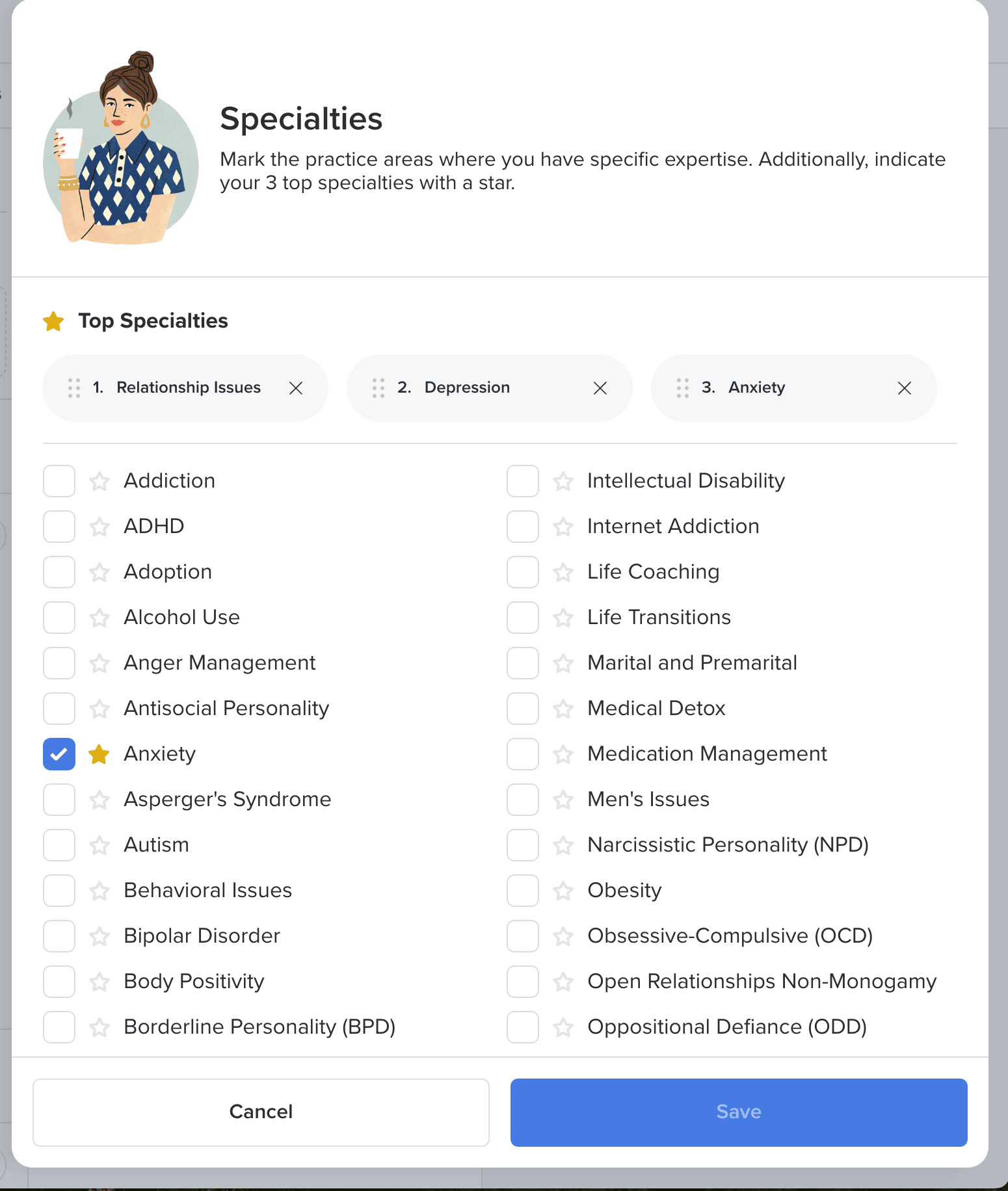
PT allows you to check multiple specialties but requires you to star exactly three Top Specialties. These are displayed prominently and act as your niche signal.
Best practices:
- Pick three and commit to them. These are the issues you want the most inquiries for.
- The order you star them in may affect how prominently they display, so lead with your strongest.
- Make sure your bio opening reflects the same issues you star.
- Do not check everything. Limit yourself to 6–10 total to avoid diluting your focus.
- Check the Participants box (Individuals, Couples, Teens, Group). This controls whether your profile appears when someone filters by client type. If you see couples but have not checked “Couples” here, you will not show up in those filtered results. It is a separate setting from specialties and easy to overlook.
Examples:
- Adults: Anxiety, Depression, Relationship Issues
- Couples: Relationship Issues, Infidelity, Communication Problems
- Trauma: Trauma/PTSD, Anxiety, Grief
- Perinatal: Pregnancy/Postpartum, Anxiety, Depression
Custom Issues (“Other Issues”)
If your specific focus area is not in PT’s prepopulated checklist, you can add it manually. At the bottom of the specialties editor, PT provides two free-text fields under “Other Issues” where you can type in custom specialties.
This is valuable for niche focuses that do not map cleanly to PT’s standard list — things like perfectionism, post-college transition, high-achieving professionals, or caregiver burnout. If a client searches for a term like that and your profile is one of the few that mentions it, you have a real advantage. Do not leave these fields blank if you serve a population that PT’s default list does not cover.
Sidebar Short-Answer Sections
These short fields appear in the sidebar and often get read before the full bio. Each has a strict character limit:
- What types of therapy do you use (400 chars). Write in plain English.
- What issues do you treat (400 chars). Expand on your specialties.
- How do you handle billing (300 chars). Be simple and transparent.
- How do you see clients (140 chars). State format and availability clearly.
Because these are scannable, they are critical for both clarity and conversion.
Sidebar Examples
What types of therapy do you use: I primarily use CBT and psychodynamic therapy. CBT helps you identify thought patterns that keep you stuck, and psychodynamic work looks at how past experiences shape your current relationships. I adjust my approach based on what you need — some clients want structured tools, others benefit from open exploration.
What issues do you treat: I specialize in anxiety, depression, and relationship problems in adults. That includes panic attacks, persistent low mood, difficulty setting boundaries, and communication breakdowns with a partner. I also work with clients navigating major life transitions like career changes, divorce, or becoming a parent.
Photos and Video
- Photo: Use a clear, professional headshot that conveys warmth.
- Office photo: Optional, but helps clients picture your space.
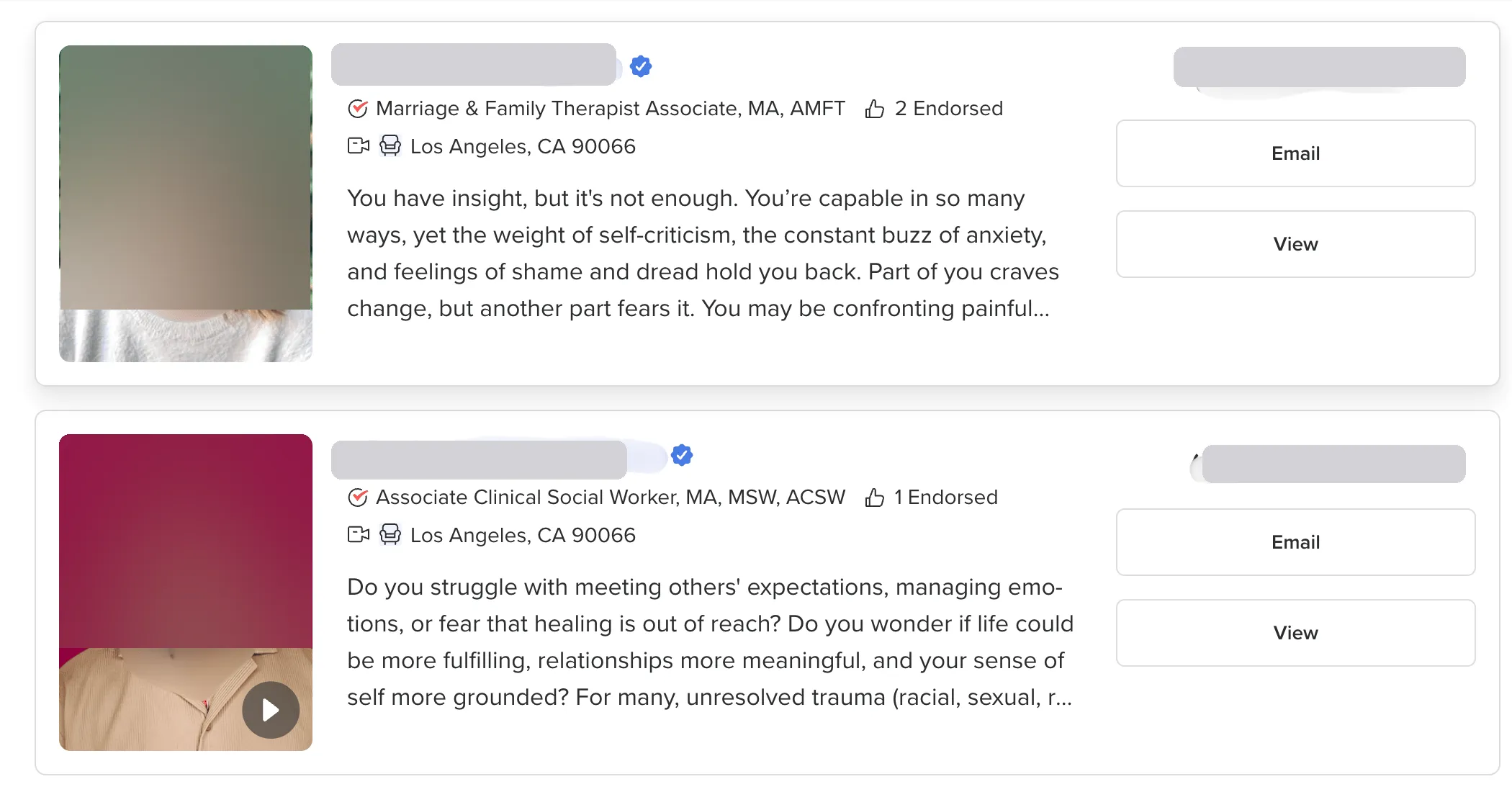
- Video (~15 seconds): This is one of the best differentiators. PT highlights profiles with video in the search listings by adding a play icon on your photo. That small icon draws the eye and makes your profile stand out in crowded search results.
A simple script works best: “Hi, I am [Name]. I help [clients] with [issues]. I would love to connect with you.”
Endorsements
Ask colleagues for specific and genuine endorsement statements. Remove generic or empty ones. A strong endorsement names the context (“I’ve referred several clients dealing with postpartum anxiety to [Name]”) rather than offering vague praise.
Therapy Groups, Group Practice, and the “Groups” Checklist
Therapy Groups
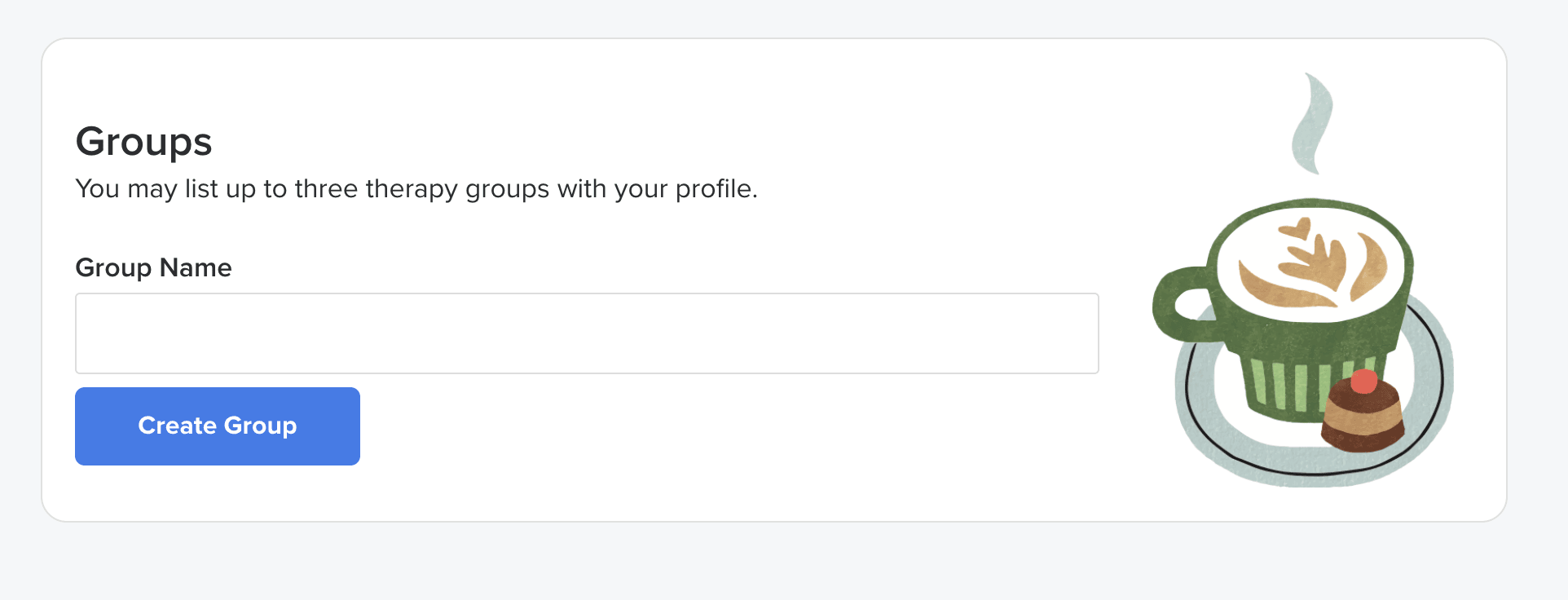
This is the “Therapy Groups” link in your dashboard sidebar. It is where you create listings for actual group therapy sessions you run — a DBT skills group, a grief processing group, a men’s support group, etc. Each group gets its own entry in PT’s Groups Directory, which is separate from the individual therapist directory.
Why listing therapy groups matters:
- Extra visibility. Each group is a separate directory entry, which gives you an additional way for clients to find you.
- Niche authority. Running a group positions you as a specialist. Being “the therapist who runs a DBT skills group” makes you a go-to referral for that niche.
- Referrals from colleagues. Therapists who do not run groups themselves often refer clients to group therapy for supplemental work.
- Community connection. Clients looking for shared support sometimes prefer a group format to reduce isolation and build connections with peers.
Group Practice (New Feature)
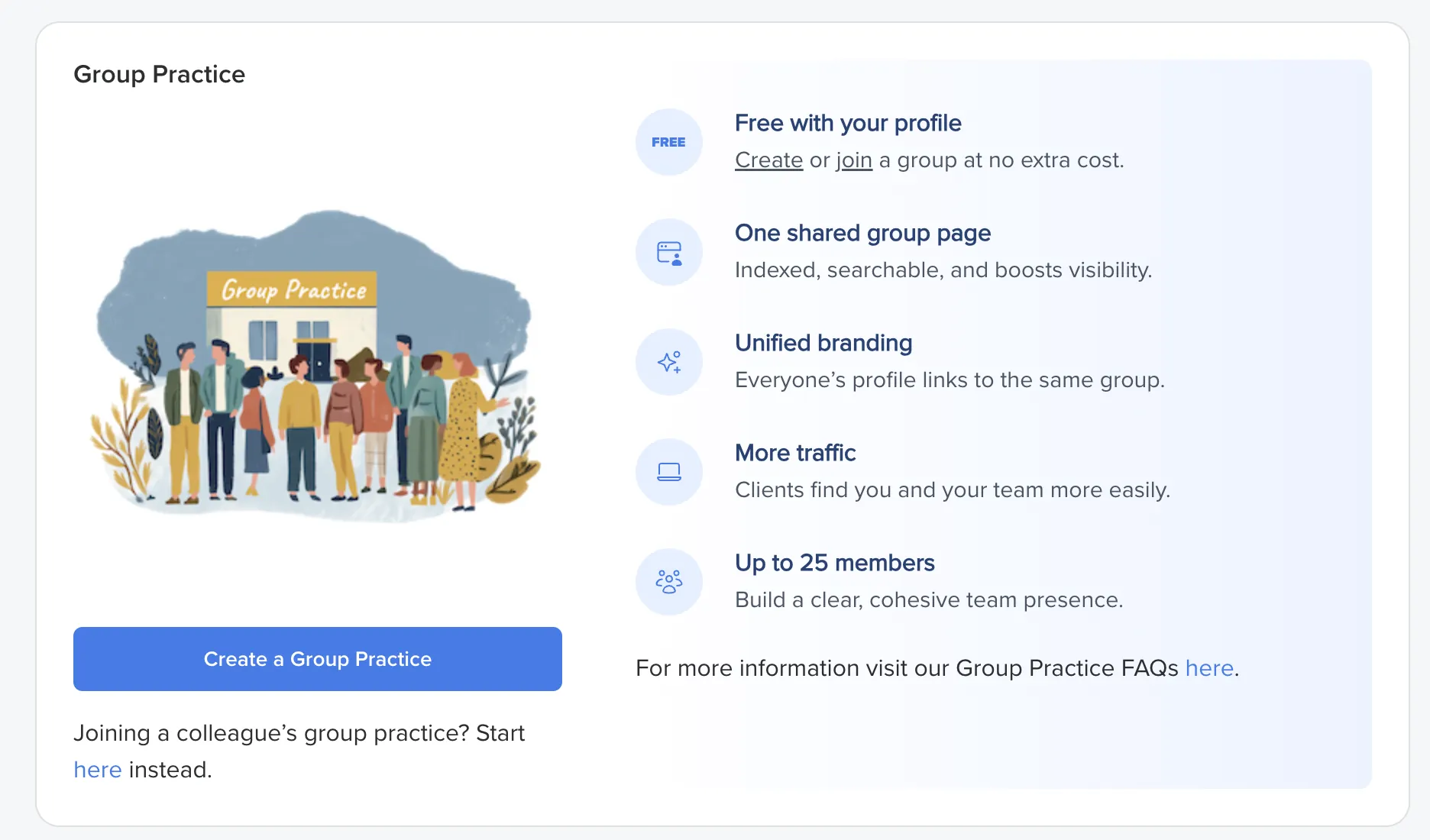
The “Group Practice” link in the sidebar — marked with a “NEW” badge — lets you create a profile for your practice as a multi-clinician entity. It is free with your PT subscription and supports up to 25 members. The group gets its own indexed, searchable page on PT, and every member’s individual profile links back to it.
This is separate from your individual therapist profile. If you run a group practice with multiple clinicians, this feature gives the practice itself a presence on PT rather than relying solely on each individual clinician’s profile.
You do not have to be the one who creates the group. If a colleague has already set one up, you can join it by clicking “Start here” under the Group Practice section in your dashboard. PT will ask for the group owner’s email address and let you include an optional message with your request.
”Groups” Checklist (Inside Edit Profile)
Inside the profile editor, there is a separate “Groups” section that has nothing to do with therapy groups or group practices. It is a checklist that asks: “Are you allied with or do you have experience supporting clients in these groups?” The options cover identities and communities — accessibility, sexual orientation, gender identity, racial justice, and others.
These are client-facing filters. When a potential client searches PT and filters for a specific population, only therapists who have checked that box appear. If you serve a particular community, check the relevant boxes. This is one of the filters that can dramatically reduce your competition in a given area, as discussed in our zip code strategy guide.
Contact Information
-
PT offers a call routing option that replaces your real phone number with a PT-generated forwarding number. This enables call tracking stats in your dashboard (you can see how many calls your profile generated). You can also add your mobile number to receive text notifications when clients reach out.
-
Our recommendation: disable call routing and display your actual phone number. You lose the call stats, but you gain something more valuable — phone number consistency across every platform where your practice appears.
Here is why that matters. Third-party sites scrape directory data. We have seen cases where an auto-generated Apple Maps business profile clearly pulled its phone number from a Psychology Today listing. If PT is showing a forwarding number instead of your real one, that incorrect number propagates to other platforms you did not create and cannot easily control.
The call stats PT provides are a “nice to have.” A consistent, correct phone number across every directory and scraped listing is more important for building trust and avoiding missed connections.
-
Respond quickly. Many clients contact multiple therapists at once and the first to reply often gets the client.
Keep Your Other Profiles Consistent
If you are also listed on platforms like Headway, Alma, Rula, or Grow Therapy, make sure those profiles match your PT listing. Modalities, licensing states, years in practice, and fee structures should be the same everywhere. Clients often check more than one directory before reaching out, and conflicting details — different specialties on PT than on Alma, or a fee range that does not match — erode trust before a conversation even starts. After you update your PT profile, take ten minutes to review your other listings and bring them in line.
Adding the Psychology Today Verified Badge to Your Website
Psychology Today offers a “Verified” badge that you can display on your own website. It is a small graphic that links back to your PT profile and signals to visitors that you are a licensed, verified provider. For therapists whose websites get direct traffic from Google, this badge serves as a third-party trust signal at the exact moment a potential client is deciding whether to reach out.
How to get it:
- Log in to your Psychology Today dashboard.
- Navigate to Profile → Verified Seal (sometimes listed under “Marketing Tools” depending on your account type).
- Copy the embed code PT provides. It is typically a small HTML snippet with an image and a link to your profile.
- Paste the code into your website. Common placements include your homepage sidebar, about page, or footer.
Why it matters:
- Trust at the decision point. A client who found you through Google, not through PT, may not know you are listed there. The badge tells them a recognized directory has verified your credentials.
- Backlink to your PT profile. The badge links to your profile, which means visitors who want more detail (endorsements, insurance info, treatment approach) can click through and see your full listing.
- Consistency across touchpoints. If a client sees your PT profile first and then visits your website, the badge reinforces that they are in the right place. If they find your website first, it gives them a second place to evaluate you.
Place the badge where it is visible but not competing with your primary call to action. A footer or sidebar placement works better than burying it in a page that clients rarely visit.
Tracking and Iteration
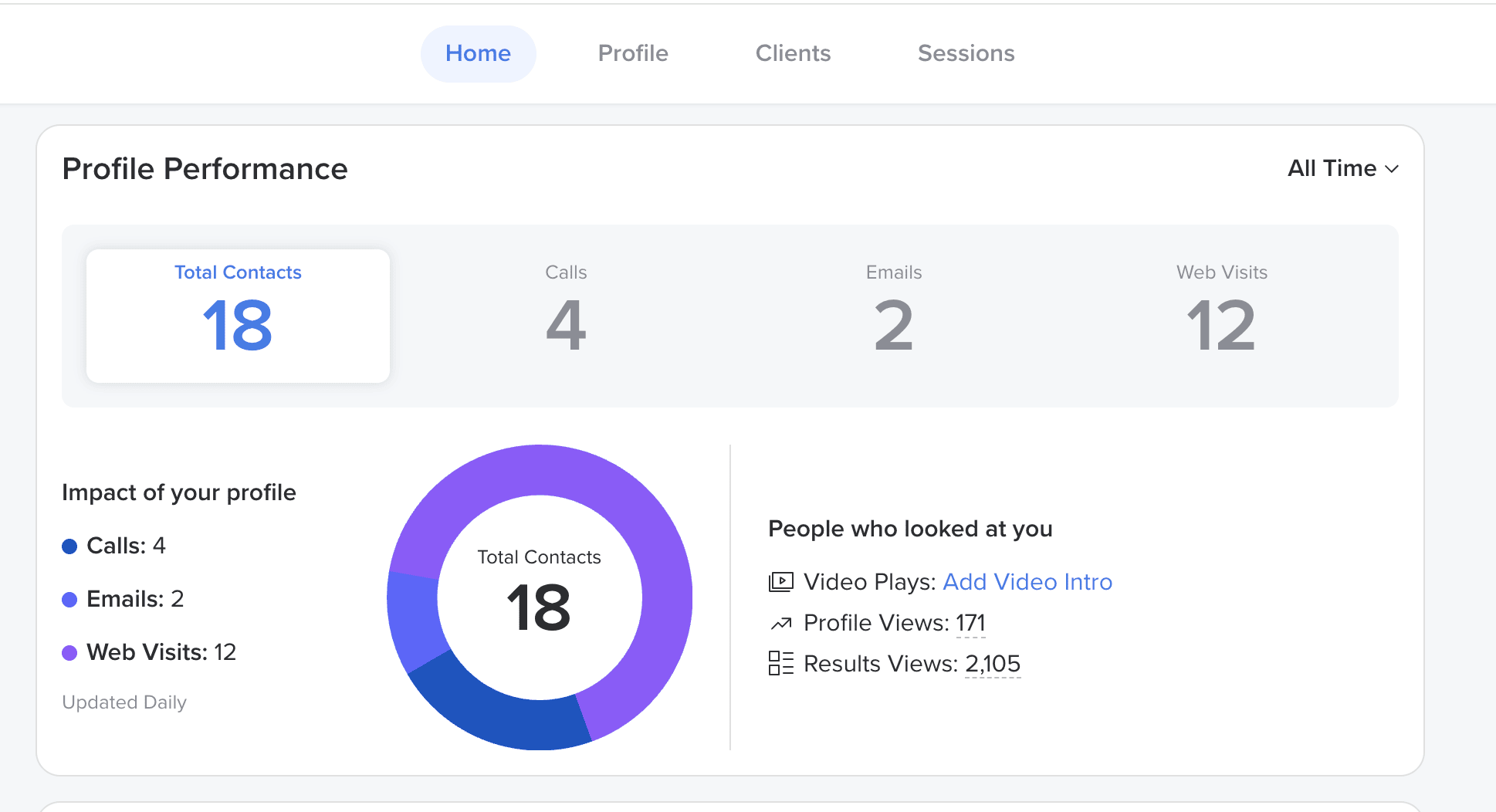
The PT dashboard shows a Profile Performance panel with a year selector. The metrics it tracks are:
- Total Contacts: The sum of all inbound contact actions from your profile.
- Calls: Phone calls generated through your listing (only tracked if call routing is enabled).
- Emails: Messages sent through PT’s contact form.
- Web Visits: Clicks to your external website link.
The same panel also shows “People who looked at you” — Video Plays, Profile Views, and Results Views. Results Views is how many times your profile appeared in search results. Profile Views is how many people clicked through to read it. Together with the contact metrics, these give you a full funnel: impressions → clicks → contact actions.
Use the year selector to compare year-over-year performance and spot trends — a decline in Total Contacts from one year to the next may signal that your zip codes or profile content need revisiting.
If Calls shows a warning icon, that means call routing is disabled and call stats are not being tracked. As noted above, we think that trade-off is worth it for phone number consistency.
What to watch for:
- If Web Visits are healthy but Emails are low, your profile is generating interest but not converting. Revisit your bio’s call-to-action and sidebar answers.
- If all metrics are declining year over year, your zip code strategy may need updating. See our companion guide on how to choose the right zip codes.
- Track quarterly at minimum. PT’s rotation system means month-to-month fluctuations are normal, but a sustained multi-quarter drop is a real signal.
Frequently Asked Questions
How do I get more referrals from Psychology Today?
To get more referrals from Psychology Today, focus on three key areas:
- Upload a professional video to your profile — the play icon draws attention in search results and significantly increases click-through rates compared to static photos
- Optimize your first 200 bio characters since these appear in search previews and act as your de facto headline
- Choose strategic zip codes where filtered competition for your specialties and insurance panels is lowest (see our zip code strategy guide)
Check your Profile Performance dashboard quarterly to track Total Contacts, Emails, and Web Visits year over year.
How do I boost my Psychology Today profile?
Boost your Psychology Today profile by making it stand out in the rotation system:
- Add a 15-second video intro — profiles with video get more clicks
- Star exactly 3 specialties that match your ideal client’s needs (not everything you’re trained in)
- Fill out all sidebar sections completely — What types of therapy, What issues, How you handle billing, How you see clients
- Upload both a professional headshot and an office photo to give potential clients a sense of your space
- Check your Participants box for the client types you actually see — if you work with couples but haven’t checked “Couples”, you won’t appear in filtered searches
How can I improve my Psychology Today profile?
Improve your Psychology Today profile by treating the first 200 characters of your bio as your headline. These appear in search result previews, so make them count.
Use “you” language to connect with potential clients. Name specific struggles they face. Match your starred specialties to what you write about in your bio opening.
Check your Profile Performance dashboard quarterly:
- If Web Visits are healthy but Emails are low, your profile is drawing interest but not converting — refine your call-to-action and sidebar answers
- If all metrics are declining year over year, revisit your zip code strategy and profile content
How do I write a good Psychology Today profile?
Write a good Psychology Today profile by following PT’s three-box bio structure:
- Imagine your ideal client — identify their struggles using “you” language in the first 200 characters
- How can you help — name who you work with, what you specialize in, and your approach in plain English
- Build empathy and invite them to reach out — describe what therapy feels like with you and close with an invitation
Avoid jargon. Check exactly 3 Top Specialties that match your bio content. Fill out all sidebar sections completely.
Your profile competes for attention in a rotation system. You can’t control when you appear, but you can control whether you convert when seen.
What makes a Psychology Today profile stand out?
Profiles that stand out on Psychology Today have five elements:
- A professional video — the play icon catches the eye in search results
- A warm, professional headshot that conveys approachability
- A bio opening that speaks directly to client pain points using “you” language
- Specificity in starred specialties — narrow focus beats trying to appeal to everyone
- Completeness — every sidebar field filled out, both a headshot and office photo, endorsements from colleagues, and the “Other Issues” fields used if your niche is not in the default list
If you run therapy groups, list them — each one creates a separate directory entry on PT. If you run a multi-clinician practice, set up the new Group Practice profile as well.
Conclusion
You cannot force PT’s algorithm to keep you on page one, but you can control how well your profile performs when it is seen.
That means:
- Use your bio opening as your de facto headline.
- Follow PT’s three-box bio format and stay within the character limits.
- Select and star your specialties with intention. Use the “Other Issues” fields if your niche is not in PT’s default list.
- Check the Participants box so you appear in filtered searches for the client types you actually see.
- Fill out sidebar sections carefully since they are highly visible.
- Upload a professional photo and a short video. The video will add a play icon in search results, which draws more attention.
- Add an Additional Location if you practice at more than one location or serve a specific area remotely.
- Disable call routing so your real phone number appears on the profile and stays consistent across every platform that scrapes your listing.
- List therapy groups if you run them — each one creates a separate directory entry.
- If you run a multi-clinician practice, set up the new Group Practice profile.
- Check the “Groups” allied-populations boxes for the communities you serve.
- Make sure your other directory profiles match your PT listing.
- Monitor your Profile Performance dashboard — Total Contacts, Calls, Emails, and Web Visits — to track effectiveness quarter over quarter.
Done well, your PT profile becomes more than a static directory entry. It becomes a reliable referral engine that connects you with the clients you most want to serve.
For more ways to improve your online visibility, see our complete guide on SEO for therapists: 10 common pitfalls and easy fixes.