Your Psychology Today profile appears in three locations. PT calls these “listing areas.” One is set automatically from your office address (labeled “Auto Listed” in the dashboard). You pick the other two. The dashboard is explicit: “You can choose up to 2 additional listing areas where you’d like to market your practice.” That is it. Three slots, plus a statewide telehealth listing if you see clients online.
Most therapists set their additional zip codes when they first create their profile and never revisit them. Maybe they chose a neighboring town or typed in the zip code closest to a second office. Reasonable enough at the time. But those choices directly affect which search results you show up in, and PT’s rotation system means you cannot control where you rank within a given area. You can only control which areas you enter.
That distinction matters more now than it used to.
PT referrals have dropped sharply for many therapists over the past few years. A December 2025 investigation by ClearHealthCosts documented the trend: therapists across the country reporting that referrals have dried up. One therapist’s contacts fell from 357 in 2021 to just 40 in 2025. Whether that decline is driven by increased competition, algorithm changes, or shifting client behavior, each listing slot carries more weight than it once did.
If you have already optimized your profile copy, photo, and specialties (and if you have not, start with our companion guide: How to Optimize Your Psychology Today Profile), your zip code selections are the next lever to pull. Choosing strategically can put your profile in front of people who are actively searching in areas where fewer therapists are competing for attention.
This post walks through a step-by-step method for selecting your zip codes using competition data from PT itself, free census and demographic tools, and insurance panel analysis. No guesswork. Just a repeatable process you can run in about an hour.
How to Change Your Zip Codes
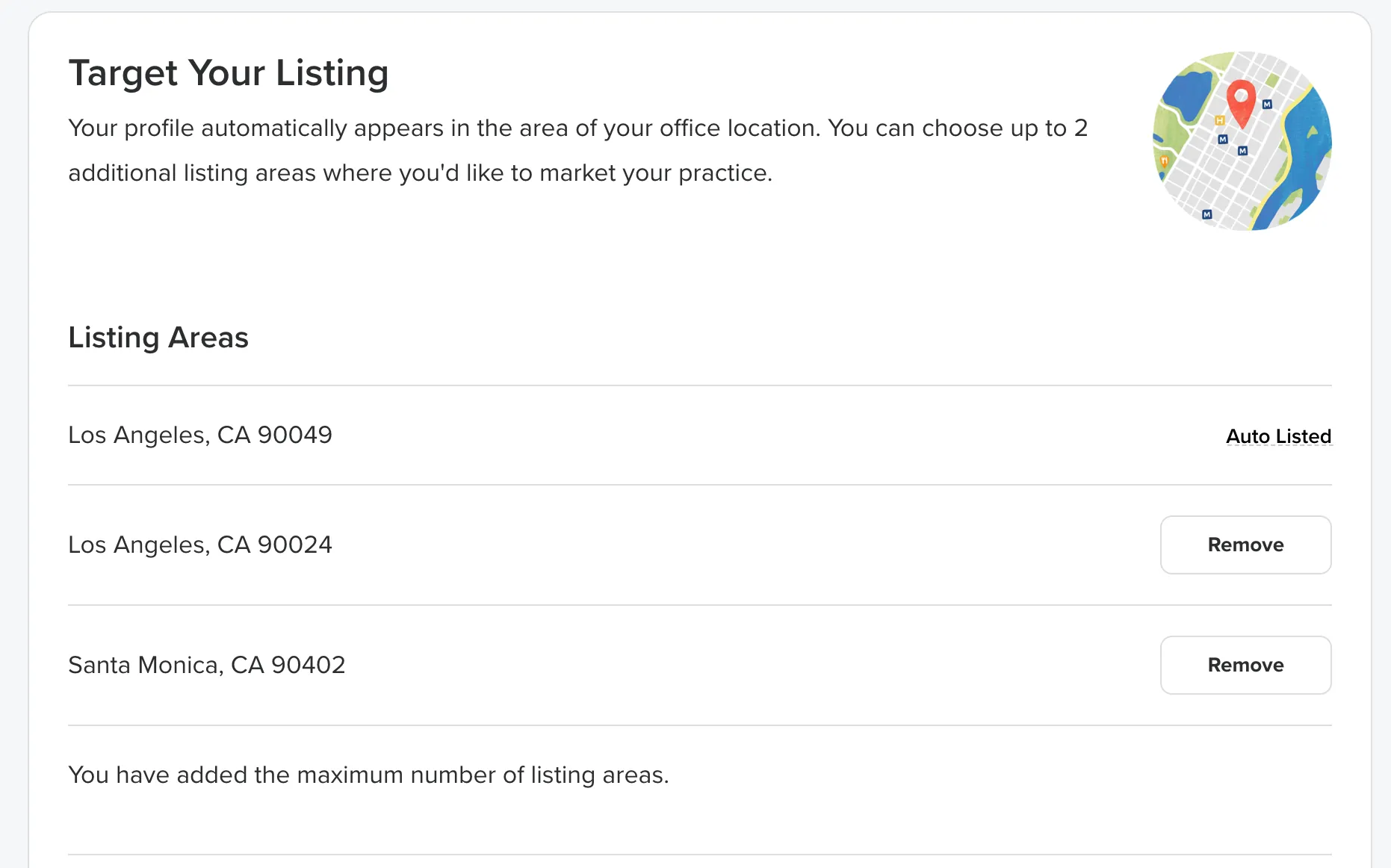
Log in to your member dashboard at member.psychologytoday.com and click “Target Your Listing” in the left sidebar (below Endorsements). You will see your office zip code marked “Auto Listed” and your two additional slots. Each additional listing area has a “Remove” button. To add a new one, enter a zip code in the search field. The change itself takes about thirty seconds. The results take longer — give it a few days before checking whether your profile appears in the new area.
Note that PT also has a separate “Additional Location” feature for adding a second practice location — physical or virtual. That is not the same thing as a listing area. An Additional Location adds an address and gives your profile a presence in that area’s search results. If you practice out of a second office or serve a specific area remotely, add it in addition to choosing your listing areas. For more on this, see our guide on optimizing your Psychology Today profile.
Once your new zip codes are live, give them time. PT rotates profiles through search results on a cycle, so you need at least 2-3 months of data before you can judge whether a zip code is working. Anything less and you are reacting to noise.
One more thing: do not swap all your zip codes at once. Change one at a time. If you replace both additional slots simultaneously and your contact requests change, you will not know which zip code caused the shift. Isolate your variables. Test one, evaluate, then move to the next.
Step 1 — Count the Competition
The number of therapists listed in a zip code is not your competition. The filtered number is.
Here is what that means. Go to psychologytoday.com/us/therapists and search a zip code you are considering. You will see a total count, something like “200+” or “800+” depending on the area. That number looks intimidating. It is also mostly irrelevant.
Now apply the filters your ideal client would use. Pick the insurance plan you accept. Add a specialty like anxiety. Maybe select “in-person” if that is what you offer.
Watch the number drop.
Search a zip code in a major metro area and you might see 800+ therapists. Filter for a common insurance plan plus one specialty and that number might drop to 40 or 50. That is your actual competitive field. Those are the profiles a prospective client scrolls through before picking up the phone.
Do this exercise for every zip code on your shortlist. The process takes about five minutes per zip code. Search, filter, record the count. Then compare.
Double-check the zip code before you enter it. Neighborhood names repeat across a state, and the wrong zip code can put your profile in a completely different city. Brentwood is a good example: 90049 is Brentwood in Los Angeles, but 94513 is Brentwood in Contra Costa County, over 300 miles away. If you type “Brentwood” into a zip code lookup and grab the first result, you might end up listed in the wrong one. Always verify the city and county attached to a zip code before adding it to your profile.
You are looking for the zip code where your specific combination of insurance panels, specialties, and session format faces the fewest competing profiles. A zip code with 800 total therapists and 30 filtered competitors is a better bet than one with 200 total and 80 filtered competitors.
Raw count is vanity. Filtered count is strategy.
Step 2 — Understand What Clients Filter For
Not all filters carry equal weight. Some eliminate half the results. Others barely move the number. Knowing which ones matter helps you predict where your profile will surface and where it will not.
Insurance is the biggest filter. When a client selects their plan, the majority of providers disappear. A 2024 study in Health Affairs Scholar scraped 1.26 million Psychology Today listings, identifying 175,083 unique psychotherapy providers, and found wide geographic variance in insurance acceptance rates. The insurance filter does not trim results. It guts them. If you accept a plan that few therapists in a given zip code take, your filtered competition shrinks dramatically.
Issues and specialties matter next. Your starred specialties on PT determine whether you appear in filtered searches. If you list anxiety, depression, and relationship issues but target a zip code where most searches skew toward substance use or eating disorders, your profile will not show up for those clients. Match your specialties to what people in your target areas are actually looking for.
Session format changes the math. Filtering for “online therapy” expands the competitive set to every licensed provider in your state. Filtering for “in-person” limits results to local therapists. If you offer both, you are competing in two very different pools, and your zip code strategy should account for that.
Demographics and identity narrow the field significantly. Language, faith, ethnicity, gender, and LGBTQ+-affirming filters can cut the results down to a handful of providers. If you already serve a specific community, say you conduct sessions in Spanish, listing in a zip code with few Spanish-speaking therapists means your filtered competition drops to almost nothing. You are not manufacturing a niche. You are finding the geography where the niche you already fill has the least coverage.
The point is not to find zip codes with fewer therapists in general. It is to find zip codes where your specific filter combination has less competition. A crowded zip code can still be your best option if nobody else in that area matches your particular profile.
Step 3 — Check the Demographics
You do not need to be a data scientist. You need five minutes and a search box.
Free census and government tools let you look up income, insurance coverage, and provider shortages for any zip code. Here are the ones worth bookmarking.
Median household income. Go to data.census.gov and search for Table B19013 — Median Household Income. This pulls ACS 5-year estimates by ZCTA (Zip Code Tabulation Area). Higher income areas generally mean more private-pay viability. If your practice is cash-only or out-of-network, this number matters a lot.
Same data, friendlier layout. Census Reporter wraps the same ACS data in a cleaner interface. Type a zip code and you get income, demographics, and insurance coverage at a glance. No dropdown menus or table codes to decode.
Insurance coverage rates. Back on data.census.gov, Table S2701 breaks down insured vs. uninsured rates by zip code. Areas with high uninsured rates may have fewer people searching PT with an insurance filter selected. That shifts the competitive dynamics you mapped in Steps 1 and 2.
Mental health shortage areas. The HRSA HPSA Find tool shows whether any address or zip code falls in a designated mental health Health Professional Shortage Area. These designations mean the area has a population-to-provider ratio of at least 9,000 to 1. Shortage areas are not just underserved. They are places where new listings get noticed because supply is genuinely thin.
County-level provider ratios. County Health Rankings publishes the ratio of residents to mental health providers for every county in the U.S. The national average sits around 340 to 1. This data is county-level, not zip code, so treat it as a rough benchmark rather than a precise signal. But if a county shows 800 to 1 while a neighboring county shows 200 to 1, that tells you something.
Five minutes per zip code gives you more information than most therapists ever look at. You are not trying to become a demographer. You are trying to make a smarter pick than the one you made when you first set up your profile.
Step 4 — Match Your Insurance Panel to the Area
This is where the prior steps connect.
You have your filtered competition counts from Step 1. You know which filters matter most from Step 2. You have income and insurance data from Step 3. Now put them together.
If you accept a specific insurance plan, say Aetna, list in zip codes where fewer therapists accept Aetna. You already found this by filtering PT search results in Step 1. The Health Affairs Scholar study mentioned in Step 2 confirmed that insurance acceptance rates vary widely by geography. Some areas are saturated with Aetna-accepting therapists. Others have almost none. That gap is your opening.
If you are private-pay only, target higher-income ZCTAs where out-of-pocket therapy is more affordable relative to household income. A $200 session reads differently in a zip code where the median household income is $120,000 than one where it is $45,000.
The key insight is simple: don’t just list where you are. List where your services are undersupplied.
Your office zip code is already locked in. Your two additional slots should go where the combination of low filtered competition, favorable demographics, and insurance panel gaps gives your profile the best chance of being seen by someone who is ready to book. Not the closest zip code. Not the most familiar one. The one where the math works in your favor.
Step 5 — Think About Telehealth Strategically
Here is what most therapists get wrong about telehealth and zip codes.
Telehealth is an attribute on your profile, not a separate listing. You check a box indicating you offer online sessions. You do not get a separate telehealth-only profile that appears in different search results. It is a filter, not a slot.
Your statewide telehealth listing already makes you visible to anyone in your licensed state who searches for online therapy. The dashboard confirms this under “Teletherapy Listing Areas”: “Your listing is showing throughout the [State] teletherapy directory.” That coverage is automatic. You do not need to spend a listing area to get it. PT also recommends adding a 15-second video introduction for optimal performance in online therapy searches.
So do not waste one of your two additional zip code slots on a town 300 miles away that you would only serve via video. The statewide listing already covers that. Your zip code slots should go to areas within reasonable distance of your office where in-person demand is high and provider supply is low.
The slots are scarce. Use them for geography that your statewide listing cannot reach: the in-person search results in a specific area.
If you hold licenses in multiple states, you get a statewide telehealth listing for each one. That is good news. But your zip code slots are still limited to two additional per profile. The math does not change. Prioritize in-person gaps. Let your statewide listings handle the rest.
When to Revisit Your Zip Codes
Your zip code strategy should change when your practice changes. Here are the triggers that should send you back to the steps above.
You add or drop an insurance panel. Your filtered competition shifts the moment your accepted plans change. Re-run the Step 1 filter counts with your updated panel.
Your PT dashboard stats drop. Check quarterly. The Profile Performance panel tracks Total Contacts, Calls, Emails, and Web Visits with a year selector so you can compare year over year. If Web Visits are steady but Emails dropped, the problem is your profile content. See our companion guide: How to Optimize Your Psychology Today Profile. If all metrics are declining, the issue may be your listing areas.
You open a second office. A new location means a new home zip code and a different radius to optimize around. Re-run the competition and demographic analysis for nearby areas.
A large platform enters your market. When Alma, Headway, Rula, Grow, or similar platforms expand into your area, they flood zip codes with new profiles fast. If your filtered competition doubled, look at adjacent codes where the influx has not hit.
You get licensed in a new state. New state, new statewide telehealth listing, and new zip code possibilities if you see clients in person across state lines.
Change no more than once per quarter. Each configuration needs 2-3 months of rotation data before you can evaluate it properly. Anything faster and you are reacting to incomplete cycles.
Get a Free Psychology Today Profile Audit
You have read through the research steps, the filter analysis, and the demographic tools. If you want someone to run the numbers for your specific practice, that is exactly what we do.
Send your Psychology Today profile URL to us and you will get back an analysis of your current zip code strategy: which codes are working, which ones might perform better, and specific recommendations based on your insurance panel and specialties. No charge.
You might also find these helpful:
- SEO for Therapists — how search optimization works alongside your PT profile
- Website Design for Therapists — when it’s time for your own site to do the work your PT profile is doing
- Local SEO for Healthcare — how zip code targeting fits into your broader local search strategy
- SEO for Therapists: 10 Common Pitfalls — mistakes that cost you rankings and referrals