
The questions I hear most from therapists are fair ones. Is SEO worth it? Does it actually work? What does it cost, and how much should I pay?
A lot of SEO reporting answers with traffic: rankings, impressions, clicks. I track all of those, but they don’t pay your rent. What you actually want to know is what a new client is worth to your practice, how many SEO has to bring in to cover its cost, and what that cost should be.
So that’s how I answer it: what SEO costs, then the math, then a calculator for your own numbers, then what the referral and billing records of a real group practice I work with show.
Client lifetime value (LTV): the total revenue one client brings your practice, from their first session to their last. For a weekly private-pay therapy client it usually runs into the thousands of dollars. That’s why the useful question isn’t whether SEO sounds expensive, but how many new clients a given price has to bring in.
What SEO costs, and what you get for it
SEO prices for therapy practices range widely. One agency might charge $200 a month, another $2,000 or more. When I collected the published prices of 13 therapist-focused SEO providers in August 2026,[1] they ran from $400 to $1,800 a month, and most sat between $600 and $1,500. Most also asked for a 3- to 6-month minimum.
What’s included varies just as much. In the plans I reviewed, a retainer in the $800 to $1,500 range usually covered your Google Business Profile, keyword research, work on your main service pages, structured data, technical fixes, some new content each month and a monthly report. Link building and digital PR were mostly saved for the top tiers.
One useful question to ask about any quote is who does the work. Some plans watch your site and tell you what to change, some make the changes on your site for you, and some also write new pages and posts. Those are different jobs at different prices, so compare quotes by what they deliver and how they’ll measure results, not by the monthly number alone.
The examples below use $1,000 a month to keep the math simple. The calculator lets you try other budgets.
The math: what one new client is worth
Start with what one client is worth, not with what SEO costs.
Take a solo therapist charging $250 a session, private pay. A typical client comes weekly for about 12 months and misses around 6 weeks along the way for vacations, illness and schedule changes. That’s 46 sessions, or $11,500 from one client.
Now the SEO side. Say you pay $1,000 a month and Google sends you 5 inquiries a month. Half are a real fit, and you sign 30% of those. Once SEO is up to speed, that works out to about 3 new clients every 4 months, or 9 a year.
| A year of SEO, once inquiries are steady | Amount |
|---|---|
| SEO cost | $12,000 |
| Lifetime revenue from one client | $11,500 |
| Clients needed to break even | 1.04 |
| New clients from search | 9 |
| Lifetime revenue from those clients | About $103,500 |
| Revenue for every $1 spent on SEO | About $8.60 |
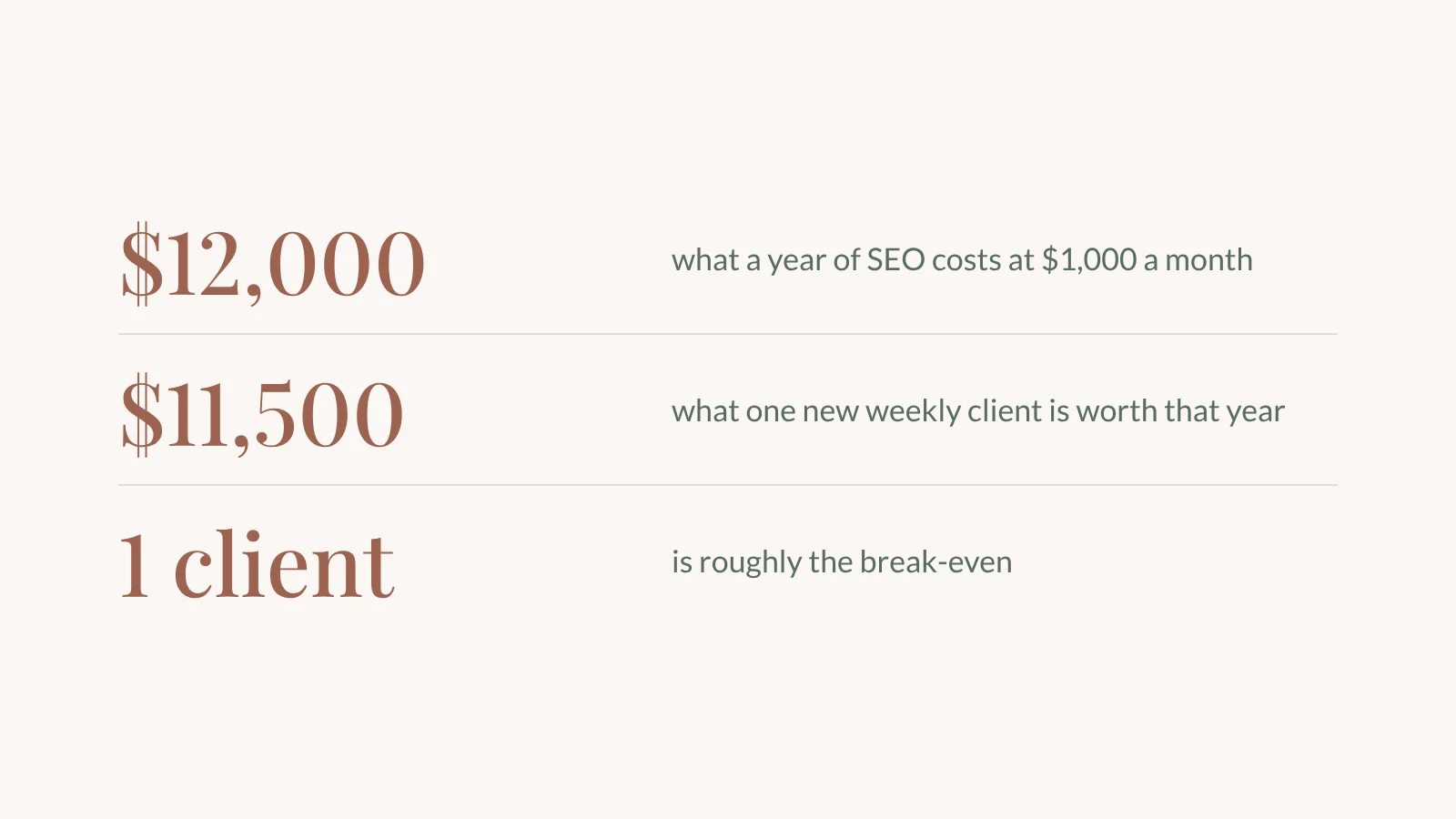
The break-even row is the whole argument. One client is worth $11,500 and a year of SEO costs $12,000, so SEO pays for itself if it brings in just over one client a year. In this example it brings in nine, at about $1,333 each. Ads on broad terms, at about $180 an inquiry and the same 15% conversion rate, run about $1,200 per client.
For a solo practice, most of what an added client pays is margin, since rent, insurance and software don’t go up with one more client. If you run a group practice, multiply by the share the practice keeps after clinician pay instead of using the full fee. In the group practice below, that share was about 39% of what its associate clinicians billed, before overhead.[2] Card processing and other per-session costs take a few more points off that.
Run the numbers for your practice
Plug in your own fee, how long your clients usually stay, and the budget you’re considering:
How much should you pay?
- Start from your break-even. Divide the yearly cost by what one new client is worth to you, which is what the calculator does. At $1,000 a month, the solo example above needs just over one new client a year. A group practice that keeps a share of each fee needs a few more.
- Match the budget to your volume. Across my solo clients, a few search inquiries a month is typical. That supports a smaller budget than a group practice filling several caseloads can put to work.
- Ask how results will be measured. If a quote can’t tell you how it will connect inquiries to clients, that’s a bigger problem than the price.
Why SEO looks like a loss for most of the first year
SEO takes time to build. In my experience, the real influx of inquiries usually starts 6 to 12 months after the work begins, while Google learns to trust the site and new pages start to rank. Those first months go into groundwork: fixing the SEO problems I see most on therapy sites and building pages worth ranking. You pay the fee from the first month. Then new clients arrive one or two at a time, each adding about $960 a month while they’re in therapy.
Here’s what that ramp does to the money, using the solo example from above:
In this example, nothing comes in for the first 6 months, and inquiries ramp up to full speed by month 12. At the one-year mark you’ve paid $12,000 and billed about $6,700, so on paper you’re behind. New-client revenue covers the monthly fee by month 10 and catches up on the running total around month 15. By month 24 you’ve billed about $86,000 against $24,000 in fees, and by month 36 about $190,000 against $36,000.
That first year is when it’s tempting to give up on SEO, and in this example, stopping then would mean quitting just before it starts paying off. So judge year one on leading signals, like rankings for the searches your clients actually use and the number of inquiries coming in, and judge it on revenue from year two on.
What one group practice’s numbers show
To check the math against reality, I matched every inquiry in a real group practice’s referral log against its clinicians’ billing records.[3] The practice is private pay with several clinicians, and I’ve done its SEO since February 2025. The search figures below cover July 2025 to June 2026, after the practice moved to a new intake form that records how every inquiry found it.[4]
The real practice beat my example on inquiry volume, conversion and retention, and came in a little lower on fee and session frequency.
| My example | The group practice | |
|---|---|---|
| Search inquiries per month | 5 | About 15 |
| Inquiries that became clients | 15% | About 32%[5] |
| Average fee | $250 | $221 |
| Sessions per month while in therapy | About 4 | About 3.3 |
| Still in therapy after 12 months | None (assumed) | About half |
Search, meaning Google plus AI assistants like ChatGPT,[6] brought in about 6 in 10 of the practice’s inquiries, more than every other source combined. Psychology Today, for comparison, sent about 2 a month. Through October 2026, 16 inquiries named an AI assistant, and 3 became clients. That’s still small, but it’s growing, and the same work drives both: clear service pages, structured data, a complete Google Business Profile and consistent listings. More on that in what actually helps you show up in AI search.
Retention was the surprise. About 73% of new clients were still coming at 3 months, 60% at 6 months, and about half at a year.[7] Clients who made it past 6 months mostly stayed.
Here’s what that adds up to:
- Per therapy client: about 35 sessions, or roughly $7,800, over their first 18 months.[8] That’s a floor, because it stops at 18 months and many are still in therapy. One-time assessments are a single fee of about $1,700.
- Per inquiry: counting the people who never booked and the assessments, each search inquiry was worth about $2,100 in revenue, and the practice kept about $800 of it after clinician pay.
- What SEO had to deliver: the practice gained about 58 new clients from search in those 12 months, each worth about $2,500 to the practice after clinician pay. At $12,000 a year, SEO had to bring in about 5 clients the practice wouldn’t otherwise have gotten, roughly 1 in 12 of those 58, to pay for itself.
What this data can and can’t tell you
It can tell you what a search client is worth, how many inquiries become clients and how long clients stay. It can’t tell you how many of those 58 clients SEO caused. Total inquiries barely moved over the period while other sources shrank, and the practice was growing, so some of the 58 would likely have found the practice another way.[9] The real question is whether at least 1 in 12 wouldn’t have. And it’s one practice, so treat it as a worked example, not a benchmark.
How SEO compares to Google Ads
Google Ads are the obvious alternative, so I priced them for the same searches. In Los Angeles, a click on “therapist los angeles” costs about $16, “therapy los angeles” about $17, and “couples therapy los angeles” about $13.[10] For health and medical businesses, roughly 7% to 12% of ad clicks turn into a lead.[11] That puts a therapy inquiry from ads at roughly $100 to $250 for broad searches like these.
A well-run campaign aimed at a niche can do much better. One solo therapist in Los Angeles running their own tightly targeted campaigns paid about $3 a click and about $60 per inquiry over more than a year, according to their own Google Ads data.[12] So the honest comparison depends on two numbers: what you spend, and what an ad inquiry costs you.
SEO beats putting the same money into Ads once it brings in more search inquiries a month than that budget would buy:
For comparison, the group practice in this post has brought in 10 to 20 search inquiries a month since mid-2025, at about $1,000 a month. That averages about 15.
At the group practice’s 32% conversion rate, ads would run roughly $380 to $680 per client on broad terms and about $190 on a campaign like that solo therapist’s. So a well-targeted campaign wins on cost per client, as long as ad inquiries convert as well as search ones. That may not hold: the one therapist whose ad data I have found ad inquiries plentiful, but fewer were a good fit for private pay.
For a solo practice at $500 a month, about 3 search inquiries a month already beats broad-term ads.
| Google Ads | SEO | |
|---|---|---|
| How you pay | For every click | A flat monthly fee |
| First inquiries | Within days | 6 to 12 months in, in my experience |
| Cost per inquiry | About $60 to $250, every month | Falls as volume grows (at $1,000 a month: $200 at 5 inquiries, $100 at 10, $67 at 15) |
| When you stop paying | Inquiries stop that day | Rankings fade gradually, in my experience |
| Audience targeting | Limited for mental health counseling | Not applicable |
Ads aren’t a bad deal. Even at $180 an inquiry, a practice that keeps about $800 from the average inquiry comes out well ahead. They do come with limits for therapists: Google treats mental health counseling as a sensitive category, so those ads can’t target your own client lists or lookalike audiences.[13] And the two cost curves run in opposite directions: Ads cost the same for every inquiry, forever, while SEO costs the same each month, so every extra inquiry lowers what each one costs.
The bigger question is what kind of investment you’re making. In a 2026 survey of 544 therapists, the type of website investment predicted a full caseload better than hours spent marketing.
How to use Ads alongside SEO
The best job for Ads is covering SEO’s slow first year, then stepping back.
- Months 1 to 6: run Ads while SEO builds. Bid on the searches you want to rank for, like “couples therapy Los Angeles” or “therapist” plus your neighborhood. Size the budget to your open hours, not to a number that sounds right.
- Months 6 to 12: turn Ads down as search inquiries arrive, roughly one for one.
- After the first year, use Ads only for specific gaps: a new clinician’s caseload, a new service, a seasonal dip or a sudden run of openings. Turn them off when the gap closes.
- Don’t pay for searches you already rank at the top for. If you’re already the first result for a search, whether that’s your practice name or a service you rank well for, ads on it can charge you for clicks you’d likely have gotten for free.
- Track Ads as their own source in your lead log, so you can see whether ad inquiries become clients as often as search inquiries do.
Extra inquiries only count if you have room for them. With a full caseload, ad spend is wasted.
What happens when you stop paying
Turning off Ads is like flipping a light switch. The day the budget runs out, the inquiries stop.
SEO doesn’t work that way. The pages you’ve built, the links and listings you’ve earned, the reviews on your Google Business Profile and the technical fixes on your site keep working after you stop paying for new work. In my experience, a year or two of steady SEO sets a foundation that keeps you ranking well after the monthly work slows down.
It doesn’t last forever. Competitors keep publishing, Google keeps changing how it ranks results, and pages slowly go out of date. So don’t build the foundation and then cut SEO off entirely. Taper it to a level you can sustain, which is something you can’t really do with Ads. (The group practice never scaled back, so its data can’t show what tapering looks like.)
If you do scale back, watch four things every month:
- Local rankings on your Google Business Profile: where you show up in the map results for your main services, in the areas you serve.
- Your highest-traffic searches in Google Search Console: the position and clicks for the handful of searches that bring most of your visitors.
- Engagement and conversions in Google Analytics: whether people still read your pages, and whether form submissions and phone clicks hold steady.
- Mentions and citations in AI answers: whether Google’s AI Overviews, ChatGPT and other assistants still name or link to your practice when someone asks for a therapist like you.
If one of these drops noticeably and stays down, that’s your signal to refresh or strengthen the pages that slipped, or to check your site’s technical health. A small slide is much easier to fix than a big one, which is what a monthly performance report is for: it shows you the change while it’s still small.
What SEO can’t do for you
I’d rather you hear the limits from me than discover them six months in.
It can’t create open hours. If your caseload is full, one more inquiry isn’t worth a full client’s lifetime value. The value shifts: filling openings quickly when clients finish, choosing better-fit clients, and holding a waitlist that supports a fee increase.
It doesn’t run your intake. In the group practice’s data, about 27% of search inquiries never replied to outreach, and another 20% talked with someone but didn’t book. SEO controls how many people reach out and how good a fit they are. How fast you respond controls how many of them become clients. Report the two separately, so a slow month of callbacks doesn’t get blamed on rankings.
Not every Google inquiry is SEO. Someone who hears your name from a friend and then searches for it would probably have found you anyway. Credit SEO mainly with people who searched for a need (“anxiety therapist Santa Monica”), not for your name. You can see the split in Google Search Console: filter out searches that contain your name or practice name, and what’s left is non-branded search. On the intake call, ask one more question: did you search for us by name, or for a kind of therapy?
Some clients leave early, and that’s normal. About a quarter of new clients in this practice stopped within 3 months. Research puts premature dropout in adult psychotherapy at about 1 in 5, across 669 studies,[14] though those studies define dropout differently from “stopped within 3 months.” Build that into your math rather than assuming everyone stays a year.
How to track SEO results in your own practice
You don’t need software for this. A spreadsheet and two habits will tell you more than a dashboard of rankings.
- Keep a simple lead log. One row per inquiry: date, source, good fit (yes or no), consult date, signed (yes or no), start date, end date and fee. Use initials or an ID number, and keep identifying details in your EHR, where they belong.
- Ask how they found you, twice. Put a dropdown on your contact form (Google search, ChatGPT or another AI assistant, Psychology Today, therapist referral, friend or family), then ask again on the consult call. In my experience, the answer on the call is more accurate. If someone was referred, write down who referred them. Until the group practice did this, a lot of its search inquiries were logged as “website.”
- Carry the original source forward. When a client adds couples work, moves to another clinician or goes from an assessment into therapy, note where they first came from. Otherwise your best SEO clients show up as internal referrals.
- Set up the technical side once. Track form submissions and phone clicks as key events in Google Analytics, add a tagged link to your Google Business Profile so you can see that traffic separately, and watch non-branded clicks in Search Console as your early signal.
- Report one number every month. Revenue billed this month from search-sourced clients, next to what you paid for SEO. Lifetime value projections help you decide whether to start. Once clients are coming in, the billed number is the one to watch.
Frequently asked questions about SEO for therapists
How much does SEO cost for a therapy practice?
It ranges widely, from around $200 a month to $2,000 or more, and what’s included varies just as much. Published prices from 13 therapist-focused providers in August 2026 ran from $400 to $1,800 a month, most between $600 and $1,500, usually with a 3- to 6-month minimum. What you should pay depends on what a new client is worth to you and how many inquiries your market can produce.
How long does SEO take to pay off for a therapy practice?
In my experience, the real influx of inquiries starts 6 to 12 months after the work begins. Revenue from those new clients then needs a few more months to catch up with the fees paid so far. In the $1,000 a month example, that puts break-even around month 15, and the gap widens every month after.
How many clients does SEO need to bring in to be worth it?
Divide your yearly SEO cost by what one client is worth to you. At $12,000 a year and $11,500 per client, that’s just over 1 client a year. A group practice should use what it keeps after clinician pay. In the data above, that was about $2,500 per search client counting one-time assessments, or about $3,050 for an ongoing therapy client, so about 4 to 5 clients a year at $12,000.
Do ChatGPT and other AI search inquiries count as SEO?
Yes. AI assistants recommend practices based on the same signals Google uses: clear service pages, structured data, reviews and consistent listings. They’re still a small source, but a growing one.
Is Psychology Today part of SEO?
No. It’s a paid directory listing, and worth tracking as its own channel. In the group practice’s data, Psychology Today sent about 2 inquiries a month, compared with about 14 from Google.
Is Google Ads better than SEO for a therapy practice?
It depends on what an ad inquiry costs you and how many search inquiries SEO brings in. Ads bring inquiries from the first week, at about $60 to $250 each in Los Angeles depending on how well the campaign is targeted, and they stop the day you stop paying. In my experience, SEO takes 6 to 12 months to ramp, then costs less per inquiry as volume grows. Many practices use Ads to cover SEO’s first year, then scale them back.
What happens if I stop paying for SEO?
Your rankings don’t disappear overnight, the way ad inquiries do. After a year or two of steady work, the pages, links, reviews and technical fixes keep you ranking for a while, but they slowly fade as competitors keep working and pages go out of date. Taper SEO to a level you can sustain rather than stopping, and check your Google Business Profile rankings, top Search Console searches, Analytics conversions and AI mentions every month for signs of a slide.
Is SEO the right investment for you?
The point of all this isn’t that SEO always works. It’s that you can know whether it’s working, in dollars, without trusting anyone’s dashboard, including mine.
If you want to see what the math looks like for your practice, send me your rough monthly inquiries, your fee and how long clients typically stay. I’ll walk through it with you, and I’ll tell you honestly if SEO isn’t the right investment for you right now. My SEO plans are billed monthly with no minimum term, and you can cancel with 30 days’ notice.
Notes and sources
[1] Published monthly retainer prices on the websites of 13 therapist-focused SEO and marketing providers, collected August 2026. These are advertised prices, and what a provider actually quotes can differ.
[2] A revenue-weighted share after clinician pay and employer payroll tax, across the practice’s associate clinicians. It’s before rent, software and other overhead, so it’s a contribution figure, not profit.
[3] Every inquiry in the practice’s referral log from January 2025 through June 2026, about 430 in all, matched to clinician billing records through October 2026.
[4] The new form went in in June 2025. Before it, many people who found the site through search and filled out the form were logged simply as “website,” so earlier months aren’t comparable.
[5] A client is anyone the referral log marks as converted or the billing records show starting with the practice, counted once per person.
[6] Inquiries whose source was Google or an AI assistant, or whose notes said they found the practice by searching.
[7] Only 23 clients had been followed for a full year, so that figure is rougher than the 3- and 6-month ones.
[8] Average time in therapy over each client’s first 18 months (about 10.6 months, from a survival analysis of the billing records) times about 3.3 sessions a month at the $221 average fee. It covers therapy clients from all referral sources, not only search.
[9] Inquiries ran about 22 a month in early 2025 and about 24 after the new form. The numbers may also undercount search: some search clients later added services or referred a friend or partner, and those were logged as internal referrals.
[10] Semrush keyword data, US database, October 2026: $15.59 per click for “therapist los angeles,” $17.42 for “therapy los angeles” and $12.83 for “couples therapy los angeles.” Semrush keyword overview
[11] LocaliQ, Search Advertising Benchmarks, 2026 data: Health & Fitness 6.94%, Physicians & Surgeons 12.43%, all-industries average 8.18%.
[12] One Los Angeles solo therapist’s Google Ads spend and conversions, June 2025 through September 2026, as reported in their linked Google Analytics account.
[13] Google Ads policy, Health in personalized advertising.
[14] Swift, J. K., & Greenberg, R. P. (2012). Premature discontinuation in adult psychotherapy: A meta-analysis. Journal of Consulting and Clinical Psychology, 80(4), 547-559. doi.org/10.1037/a0028226